
When to use short URLs?
In today’s digital marketing landscape and fast-paced communication environment, short URLs have become vital tools for brands and businesses. According to this report by Verified Market Research, the global URL shortening services market was valued at $119.8 million in 2023 and is projected to reach $560.56 million by 2031, with a compound annual growth rate (CAGR) of 19.8% from 2024 to 2031.
So, why opt for short URLs? There are many legitimate reasons, as short URLs save space, enhance visual appeal, and allow for link performance tracking. They build user trust and increase brand recognition.
But when should you actually use them? Let’s explore the scenarios where short links excel and discover when it might be better to stick with the original, non-shortened URL.
1. Quick overview of the role of URLs in digital navigation
URLs (Uniform Resource Locators) serve as unique addresses that connect users to resources across the web. They are the backbone of digital navigation, whether you’re clicking a link in a chat, tapping a banner ad, or diving into search results, it all begins with a URL.
Standard URLs can be long and unwieldy, often packed with the protocol (https://), domain name, path, query parameters, and anchor tags. They can be a mouthful, especially when auto-generated.
Enter short URLs. They are sleek, condensed versions of standard links, typically created through services like Cut0. They’re easy to remember, visually appealing, and perfect for marketing, social media, and performance analytics.
2. Why go with standard URLs?
Even with the rise of short links, standard URLs remain very important, especially when SEO, transparency, and control over link structure are at stake.
SEO performance
Standard URLs often incorporate keywords that reflect the page’s content, helping search engines understand the relevance of the page and improve its search ranking.
For instance, a URL like https://example.com/blog/top-10-travel-destinations-2026 is far more informative and SEO-friendly than a generic, shortened version.
In fact, a comprehensive analysis by Backlinko, examining a staggering 11.8 million search results, revealed that shorter, descriptive URLs often have the edge in search rankings. URLs landing in the coveted number one position were, on average, 9.2 characters shorter than those sitting in the number ten spot. This underscores the power of brevity and clarity in the digital landscape.
Trust factor
Users are more likely to click on links that feature a familiar domain and a clear path. A standard URL shows exactly where the link leads, with no hidden redirects. This transparency is key, especially in email newsletters, blog posts, and when dealing with cautious or security-minded audiences.
This study from the University of Edinburgh found that users often struggle to figure out where a link goes, particularly when the domain is buried in a subdomain. Unsurprisingly, only 8.3% of participants could accurately identify a link’s destination in those cases. This shows just how vital clear, human-readable URLs are for building trust.
Branding & identity
Think of a URL as an extension of your brand. It can showcase your company name or product identifiers, all of which help boost brand recognition.
According to this article by researchers at SpaceLama, a brand’s identity, including digital elements like its URL, plays a significant role in shaping consumer perception and purchase decisions. Consistent, branded URLs in corporate blogs, product pages, and press materials create a seamless brand experience.
Redirects & management
Standard URLs are a better fit for complex infrastructures. They can be easily managed within a CMS, tracked in analytics platforms, used in A/B testing, and customized with precise redirects. For instance, you can manually tweak a URL’s path structure without needing to rely on a third-party tool.
Disadvantages: cumbersome & inconvenient
The biggest issue with standard URLs is their length. They can be long and hard to remember, and they often get cut off in emails or messaging apps. This makes them impractical in places with character limits like X (formerly Twitter) or an Instagram bio.
- X (formerly Twitter): maximum 280 characters per post.
- Instagram bio: 150-character limit.
Long URLs also look bulky in printed materials and can make QR codes harder to scan, reducing their usefulness in offline campaigns.
3. Why go short?
Short URLs have become essential in both digital and offline marketing. Their compact size and versatility make them ideal for various use cases, from social media posts to print materials.
Space saving
Short links are especially helpful in places where space is limited, like X (formerly Twitter), SMS, push notifications, or email signatures.
When every character counts, a concise URL allows you to include more meaningful content and improves readability.
User friendliness
Short links are easier to read, remember, retype, and say out loud. This is particularly useful in messaging apps, live presentations, or any verbal communication.
For example, cut0.link/travel2025 is much simpler and easier to share than a long, complex URL.
A scientific study with 170 participants found that content with multiple short links led to better comprehension, user engagement, and behavior. This is likely due to their visual simplicity and ease of use.
Aesthetic appeal
From a design standpoint, short URLs look cleaner and more polished. Whether on business cards, banners, product packaging, or social posts on Instagram or TikTok, short links help your brand appear more professional and visually consistent.
Advanced analytics
Link shortening services like Cut0 provide built-in analytics that allow you to track click volume, user location, devices, referral sources, and more. These insights help you assess campaign performance and make informed decisions.
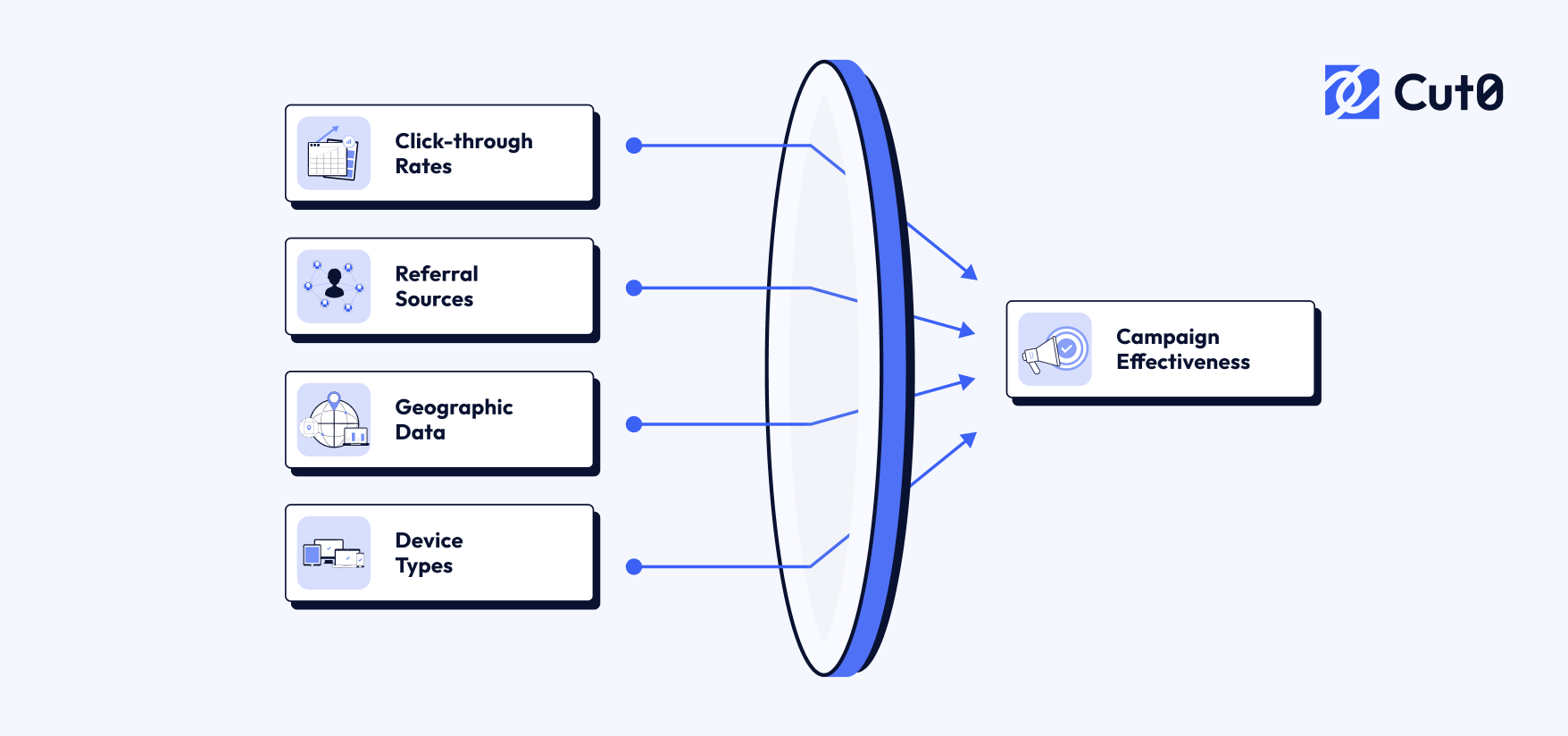
Offline marketing
Short URLs are great for offline use, such as on flyers, business cards, billboards, or product labels. They work well with QR codes, ensuring quick and easy interaction with your audience at all touchpoints.
4. Considerations for short URLs
While short URLs have many benefits, they also come with some limitations. To use them effectively, it’s important to be aware of potential risks and choose reliable tools from the start.
Risk of expiration
Some free or unstable URL shortening services may deactivate links after a certain period or when usage limits are reached. This can lead to broken links and inaccessible content, which is especially problematic for long-term campaigns or evergreen materials. Use Cut0 to ensure that your links won’t expire unexpectedly.
Service reliability
The platform you choose is important. If the service shuts down or has technical issues, all your links may stop working wherever they were used. That’s why it’s essential to select a trusted and stable solution like Cut0, which offers long-term support, reliable infrastructure, and data protection.
Limited context
Unlike standard URLs, short links don’t reveal any information about the destination. A URL like cut0.link/xYz1 gives users no insight into what to expect. Probably something scary and unsafe. This lack of transparency can erode trust, especially when links are shared in unfamiliar contexts or when marketing to new, untested audiences.
To address this issue, Cut0 allows you to use your own custom domains as well as custom URL slugs so that you can turn cut0.link/xYz1 into yourdomain.com/discounts in a couple of clicks.
5. When to use short URLs?
Choosing the right type of URL depends on your campaign goals, distribution channels, and how you expect users to interact with your content.
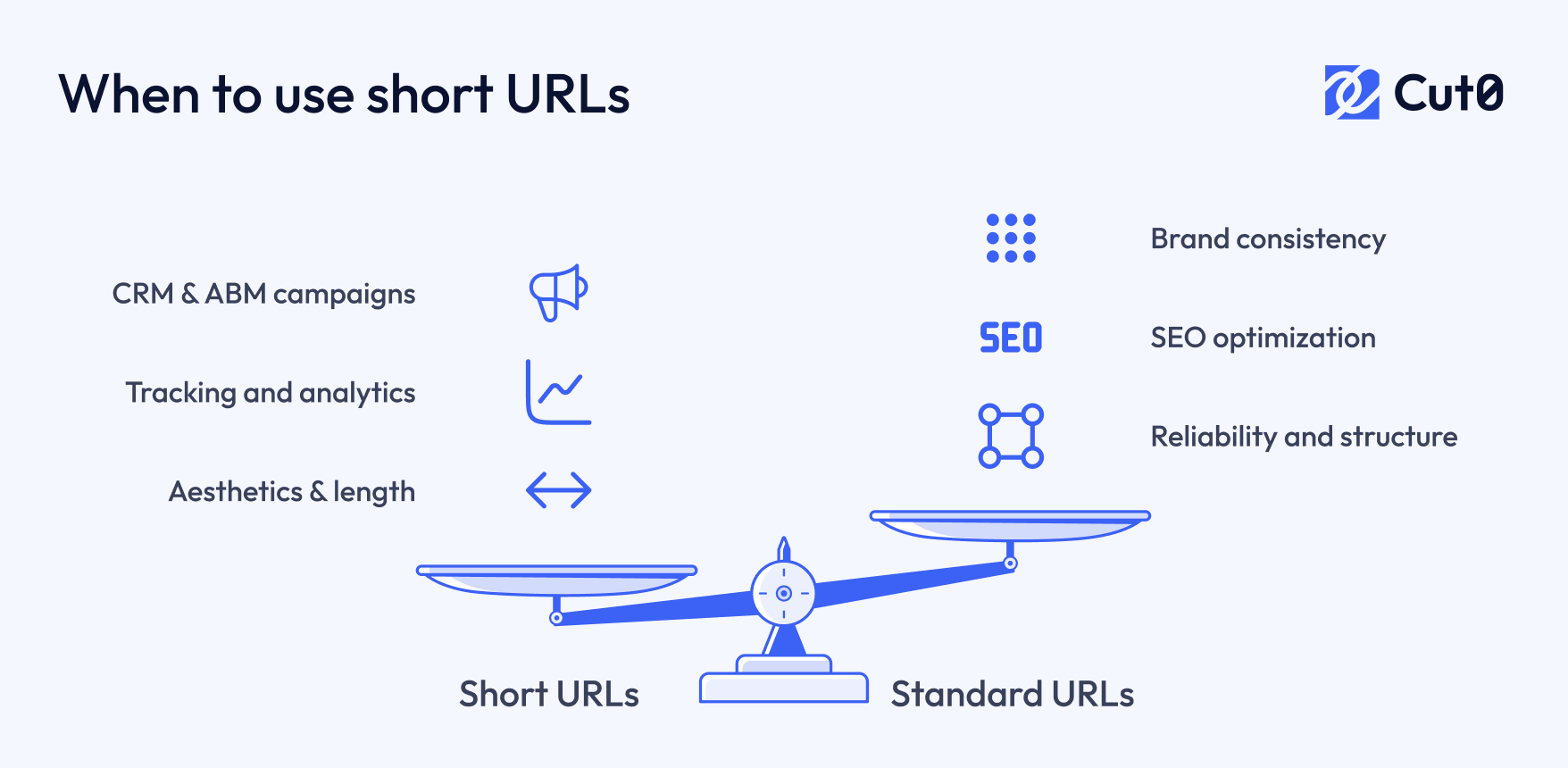
Use standard URLs for when transparency and structure matter most.
Use standard URLs if your campaign focuses on:
- SEO optimization, because keyword-rich URLs help improve search engine visibility;
- building trust, because readable, recognizable URLs increase click-through rates, especially in unfamiliar or sensitive markets;
- brand consistency, since URLs containing your brand or product name help reinforce identity;
- advanced infrastructure. It seems that standard URLs are still the go-to for CMS integration, custom redirects, and managing a structured site architecture.
Use short URLs for when usability and link tracking are key.
Opt for short URLs if your campaign focuses on:
- social media, because on social media brevity and aesthetics matter. Also, those dreaded character limits push you to make things shorter and more concise;
- SMS and messaging apps, to conserve character space and improve user engagement;
- CRM and E-mail marketing, where tracking the behavior of individual recipients is essential;
- print campaigns. Use Cut0 short links on business cards, flyers, and various packaging. Short URLs are easier to read and scan, that’s true, but also it’s the only way to track performance of the printed links, and you can easily track multiple sources leading to one single landing page if you use unique branded short links for each offline ad, each magazine, billboard, etc.;
- analytics and A/B testing because you need to get granular insights into each click or traffic source;
- Account-Based Marketing (ABM) to track interactions from specific accounts and leads using unique links for each one of them. That’s especially important for high-ticket B2B sales teams with long sales cycles.